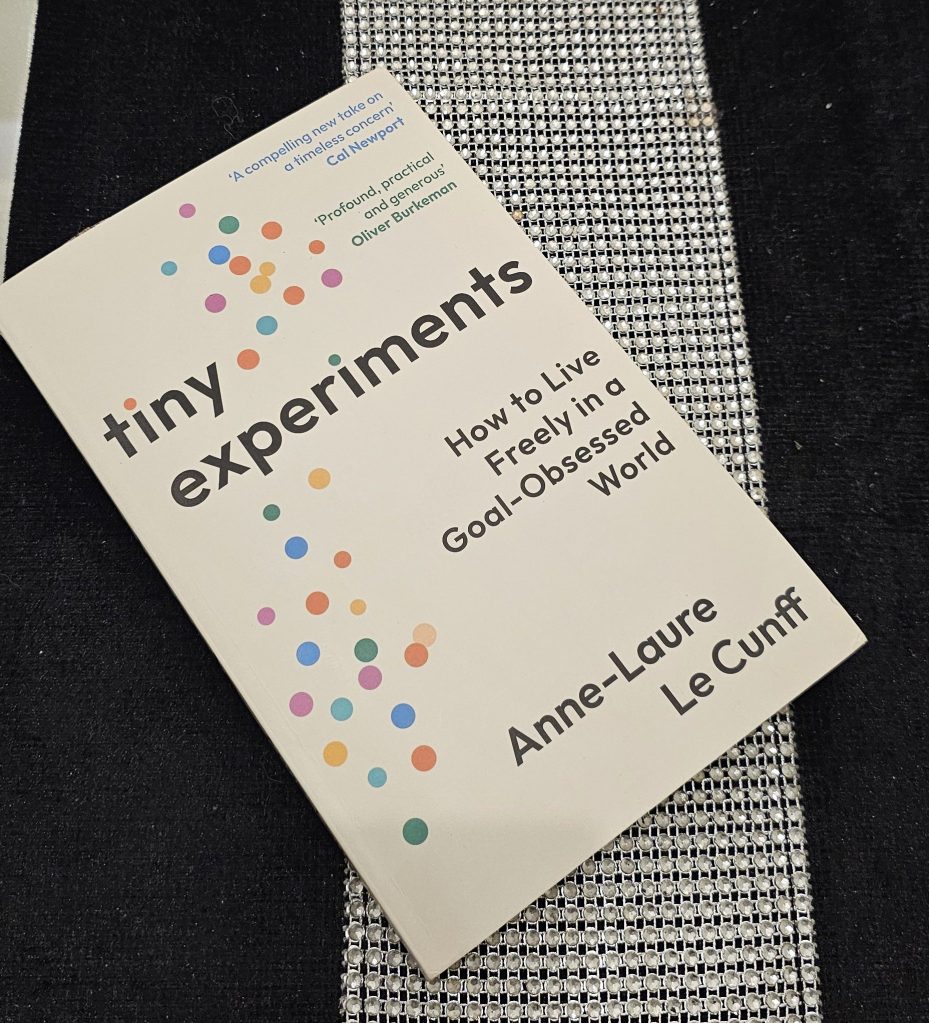
Book Review: Tiny Experiments

Book: Tiny Experiments, How to Live Freely in a Goal-Obsessed World

Author: Anne-Laure Le Cunff, neuroscientist, entrepreneur and educator

Key message of the book: The book is an invitation to approach life differently, by moving away from the more traditional and rigid goal setting framework (e.g. SMART goals) and embracing the concept of “tiny experiments”, following our own curiosity and genuine interests. The PACT (Purposeful, Actionable, Continuous and Trackable) framework – e.g. “I will publish 25 newsletters over the next 25 weeks”- encourages us to experiment without getting hung up on specific goals. It is more about trying new things, collecting data and feedback, and ultimately letting the experience guide us – it does not matter if we continue, stop or push for higher goals from the initial PACT. The journey in itself is the catalyst for growth: “Compared to linear goals, a pact fosters an experimental mindset – an attitude of openness and curiosity, a willingness to learn with a sense of receptiveness, and a lack of preconceived notions.”

One reflection practice supporting the “tiny experiments” framework is highlighted in the book as the Plus, Minus, Next journaling practice, whereby we let our brain unload positive or negative developments of the day, week or month, and next steps we can experiment with, creating compounding growth.

Some favorite quotes from the book:

“Confidence isn’t a quality we are born with or something that magically happens; it’s built through action. To create confidence, you need to get started. Every time you act, you bet on yourself and gather evidence that you can do what you set out to do.”

“…the most reliable way to be successful is to try, fail, learn and try again.”

“When you focus on being more – finding ways to be present and to slow down time – you can avoid burnout without abandoning your ambitions.”

“You are an evolving canvas, an unfolding story, a great work in the making. All you can do is imagine a world of possibilities and keep on experimenting until you discover what works. Each experience, whether a success or a failure by conventional standards, opens new doors, which you’ll pass through with new capability and wisdom.”

“This is how you discover your life’s meaning—by focusing on your daily actions rather than the content of your future eulogy. When generativity becomes your focus, the immediate impact of your actions is all the motivation you need. Every pact you make, every shift, every “What if?” becomes not just a step in your own journey, but a chance to inspire and elevate others. Your career is no longer a linear ladder you climb alone, but a nonlinear path of shared discovery.”

“When we fixate on finding one singular purpose, we rule out the side quests that help us grow the most. Your life doesn’t need to follow predictable acts and arcs. The best stories are full of surprises, with colorful characters and unexpected plot twists.”

“When we use trial and error, we set in motion a series of growth loops where progress emerges in conversation with our environment. Each cycle adds a layer of learning to how we understand ourselves and the world around us. Instead of an external destination, our aspirations become fuel for transformation. We don’t go in circles; we grow in circles.”

“We think that once we get to that destination, we’ll be happy. What most people discover is that once they get there, they’re still the same person. All of their other problems are still here. And they’re not any happier. That’s one of the main reasons to stop focusing so much on the end goal and focus on the process instead. By focusing on the process, whatever the outcome, you’ll still be happy exploring and experimenting while you’re getting there, during the journey.”

This book review by Growth Is A Journey is an invitation for readers to discover the book in its entirety.

Managing Overwhelm

Diocletian Palace – Cathedral Bell Tower, Split, Croatia

Nelson Mandela once said: “The brave man is not he who does not feel afraid, but he who conquers that fear.” Likewise, being productive and determined in the pursuit of one’s goals does not mean living a life without overwhelm. It is quite likely that sooner or later, or at repeated times, we find ourselves in a state of overwhelm, challenged by the scope or number of challenges to tackle, be it at home, work or both.

Overwhelm is usually experienced as anxiety, stress, or lack of control over our daily routines and life experiences.

The feeling of overwhelm is not entirely bad news, as long as we are dealing with it effectively.  This doesn’t mean that we should focus our energies to banish it once and forever. It simply means that every time we feel overwhelmed, as often as that might happen, we don’t spin out of control, but we use our gained awareness for self-empowerment, by turning the state of overwhelm into a steppingstone for growth and as feedback for continuous improvements in our lives.

There are three simple steps to managing overwhelm, which I call ABC:

  • Step 1: Acknowledge
    • Taking gauge of our overwhelm levels is critical to avoiding burnout and operating at our highest productivity levels. Chronic or acute pain, lack of sleep or other physical ailments are typical signs of overwhelm or even burnout.
    • The act of acknowledging overwhelm is allowing us to pause before some recalibration and action. We are, often times, one deep breath away from the path that leads to success.
  • Step 2: Be bold
    • Simply acknowledging that we are overwhelmed does not mean conquering overwhelm. Even if we might not feel like it, it is important to set ourselves into motion – by thinking of what’s most important for us to do in that moment, and what steps we can take. Then, simply go about it and do it! This could include making a phone call, signing up for a class, or simply taking a nap or many naps if you are chronically tired.
    • Boldness can be in the action to be taken but it could also be in what we are deciding to no longer act upon, or in what could be placed on hold, abandoned or replaced.
    • This step is, at the end, deciding in that particular moment what our top priorities are – at least on the very short term – which ought to be aligned with our top values and in touch with our limited time and resources. This can be done by assessing what can wait, what is time sensitive, what is important, what can be delegated, or where we might need to get help…If this part is hard, use the 5-year test … imagine yourself 5 years from now and think of what would matter the most that you have done or achieved in that moment.
  • Step 3: Celebrate
    • We are human beings and not human doings.
    • Often times, we underestimate the power of rewarding ourselves after taking a first step, reaching a milestone or meeting a goal. The more we celebrate ourselves and grow into our biggest cheerleaders, the happier and more resilient we become.
    • A reward can take many forms including rest, time set aside for a hobby, or simply being around positive people, who understand the cathartic power of celebrating wins and victories of ourselves and of these around us.

As simple as these ABC steps might appear, they are effective because they are pushing us away from overwhelm into an empowered mindset, confident in and at peace about our choices, priorities and immediate action.

And if you are on the lookout for some further tips on managing overwhelm, several listed below were learned the hard way on my own personal and professional journey:

  • Every time you remember something to do or act upon, write it down in your notebook, planner, or your calendar, …
  • Do a regular brain dump…listing all items that are on your mind, some of them turned into clutter.
  • If you can’t make progress or you have too many things you would like to accomplish, make a point to spend 15 minutes on each of your goals every day or have dedicated blocks of time in the week for your top 3 goals. If you have more than 3 goals, think about what can be put on hold or sequenced in a way that doesn’t put stress on your limited resources. Think what goals could be thought of in terms of ranges and could be deemed achieved whether it’s at minimum, average or maximum levels: e.g. the goal of being fit could be deemed achieved in a week by going to the gym anywhere between 2 and 5 times.
  • Be mindful of how many workstreams are started vs completed. It can be more productive and less stressful to not start something new, until the item that might clutter your planner, or mental and physical energy is covered. Sometimes it takes overall less energy to get that item done, rather than to carry it through on your to-do list from a day, week, month to another – taxing your energy and happiness levels.
  • Ask for help, rest, take breaks. This is something that could make type A personalities uncomfortable, while high achievers understand that balance and high productivity are not something we achieve 24/7 but an optimization function across emotions, resources, energy, and responsibilities.

Although our brains like us to think we are perpetually in survival mode, it behooves us to draw a line in the sand and pragmatically deal with overwhelm. We are powerful human beings with the capacity to pause, take action, then celebrate; these are three simple steps which, if turned into a lifestyle, have the potential to lead to beautiful and fulfilling lives.