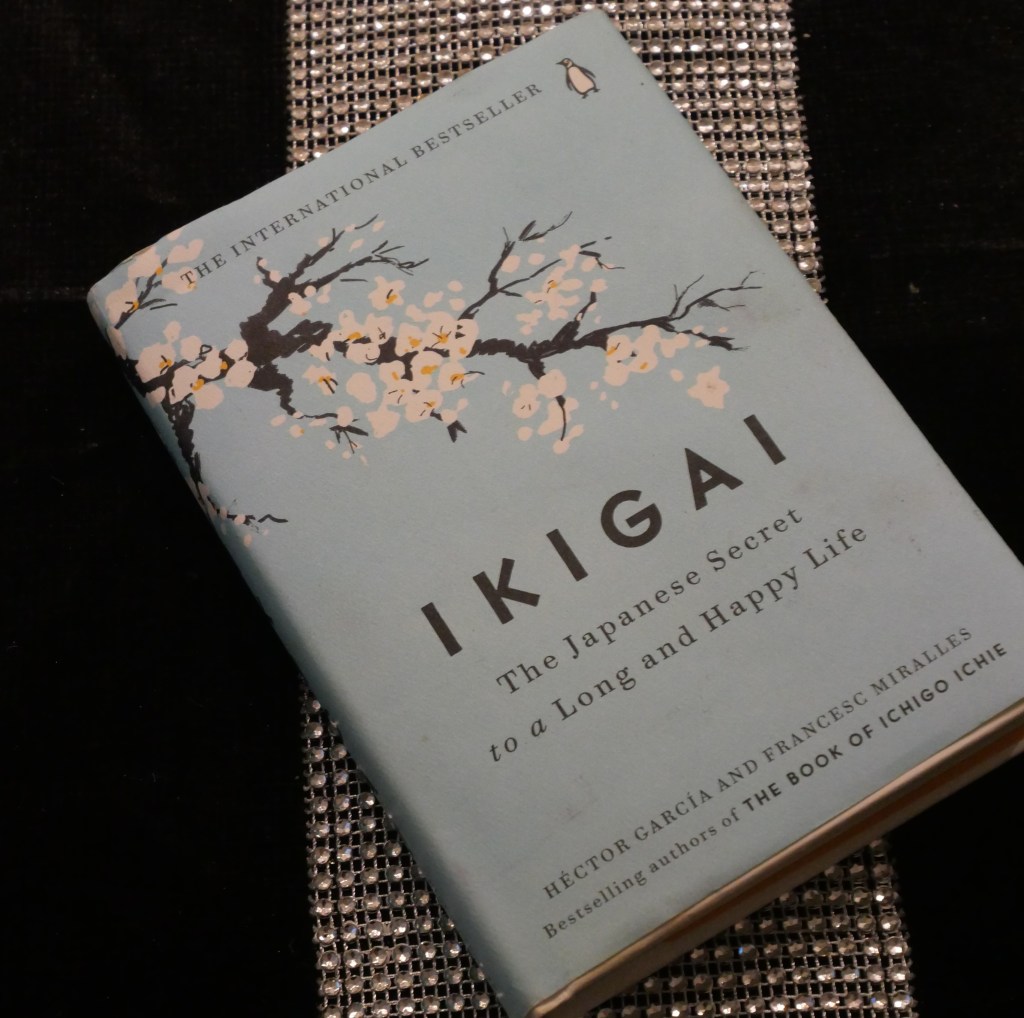
Book: Ikigai, The Japanese Secret to a Long and Happy Life
Author: Hector Garcia and Francesc Miralles
Key message of the book: The book is focused on capturing the Japanese concept of Ikigai, which can be translated as “a reason for living” or “the happiness of always being busy“. Ikigai is associated with living a long (and fulfilled) life, as demonstrated by the extraordinary longevity of residents of the Okinawa Island of Japan, one of the world’s Blue Zones with the largest population of centenarians.
The authors went on a search to document the lifestyle of Okinawans and discovered that Ikigai was a core component of their longevity, in addition to: maintaining a healthy diet or Okinawa’s miracle diet (with antioxidants-rich food and drinks like green tea and white tea, fish and many fruits and vegetables, and a principle to eating less than our hunger might demand or the 80% rule), practicing low-intensity physical activity (like yoga and tai chi), and keeping close bonds within their local communities.
Ikigai is to be seen as “the reason we get up in the morning” and should be found or discovered at the intersection of our passion, mission, vocation and profession – by addressing the following questions: What we love, What we are good at, What we can be paid for, and What the world needs.
Our ikigai is to be discovered and preserved:
- Finding our own unique ikigai involves identifying when we are in a state of flow or “optimal experience”, defined further by psychologist Mihaly Csikszentmihalyi as “the state in which people are so involved in an activity that nothing else seems to matter; the experience itself is so enjoyable that people will do it even at great cost, for the sheer sake of doing it.’ Flow is therefore a clue to our ikigai – “keep busy by doing things that fill you with meaning and happiness” – and a key ingredient for happiness: “The happiest people are not the ones who achieve the most. They are the ones who spend more time than others in a state of flow.”
- Preserving our ikigai requires resilience to weather adversity and overcome setbacks: “The more resilient we are, the easier it will be to pick ourselves up and get back to what gives meaning to our lives.” Going beyond resilience is antifragility, the ability to “get stronger when harmed“.
One specific learning from the book: Two additional Japanese concepts interlinked to ikigai are wabi-sabi and ichi-go ichi-e. Wabi-sabi means “the beauty of the fleeting, changeable and imperfect nature of the world around us“. Ichi-go ichi-e means “this moment exists only now and won’t come again.” By focusing on the present and appreciating the beauty of imperfection, we can remain guided by our ikigai in our day to day lives.
One favorite quote from the book: “When we spend our days feeling connected to what is meaningful to us, we live more fully; when we lose the connection, we feel despair.”
One favorite passage from the book:
“Once you discover your ikigai, pursuing it and nurturing it every day will bring meaning to your life. The moment your life has this purpose, you will achieve a happy state of flow in all you do, like the calligrapher at his canvas or the chef who, after half a century, still prepares sushi for his patrons with love.”
Addit
Growth Is A Journey book review is intended to represent 1-2 key nuggets of insights from the book, with an invitation for readers to discover the book in its entirety.
 Growth Is A Journey
Hi Helen,
Ikigai represents indeed the beautiful intersection where our passions, talents, purpose, and the world’s needs come together to form the meaning in life.
I adore the concept!
Thank you.
LikeLiked by 1 person